When someone looks at a boat moored in a marina, they usually see two things: leisure and luxury. It is the most common reading and also the most incomplete. Behind that hull lies a supply chain involving the chemical industry, metalworking, fine joinery, onboard electronics, naval engineering, logistics, tourism and specialised services.
This is the argument ACATMAR, the Brazilian Nautical Association, has been making for years: the marine sector is not a luxury good, it is an economic chain that generates jobs, income, tourism and development. The best way to prove it is with numbers.
We have gathered here, in one place, the most current official data on the sector, cross-referencing the bulletin of the Santa Catarina State Planning Secretariat, the Sebrae sector study, the Brazilian Navy's records, IBGE's Ocean GDP methodology and ACATMAR's own surveys. It is reference material, made to be used by those who need to defend the sector with data in hand.
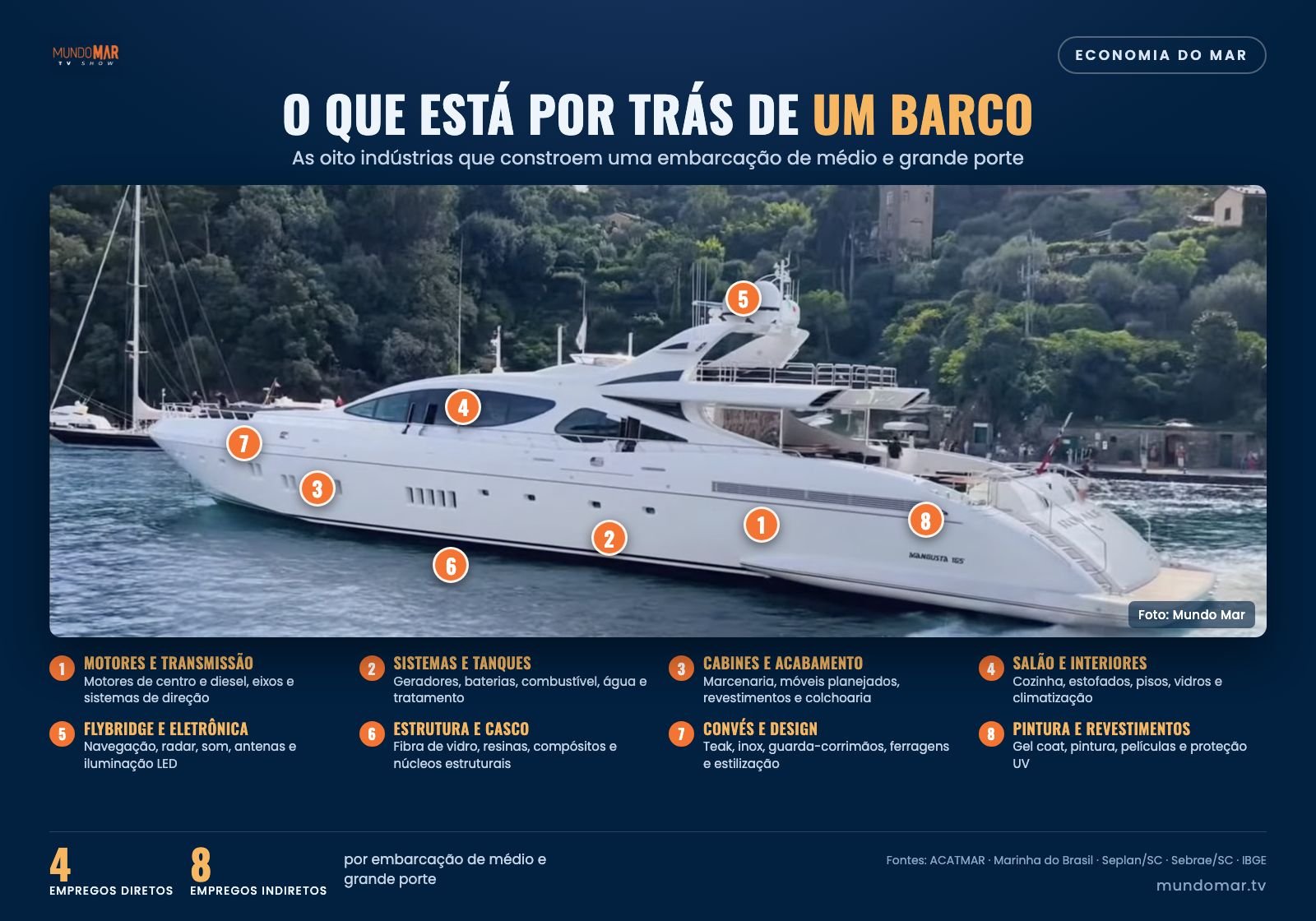
A boat is not a product, it is the assembly of eight industries
Building a medium or large vessel means bringing together, under the same roof, suppliers from sectors that are rarely associated with yachting:
1. Engines and transmission: outboard, inboard and diesel engines, shafts and steering systems
2. Systems and tanks: generators, batteries, fuel, water and treatment
3. Cabins and finishing: joinery, fitted furniture, linings and upholstery
4. Salon and interiors: galley, soft furnishings, floors, glazing and climate control
5. Flybridge and electronics: navigation, radar, audio, antennas and LED lighting
6. Structure and hull: fibreglass, resins, composites and structural cores
7. Deck and design: teak, stainless steel, handrails, fittings and styling
8. Paint and coatings: gel coat, paint, films and UV protection
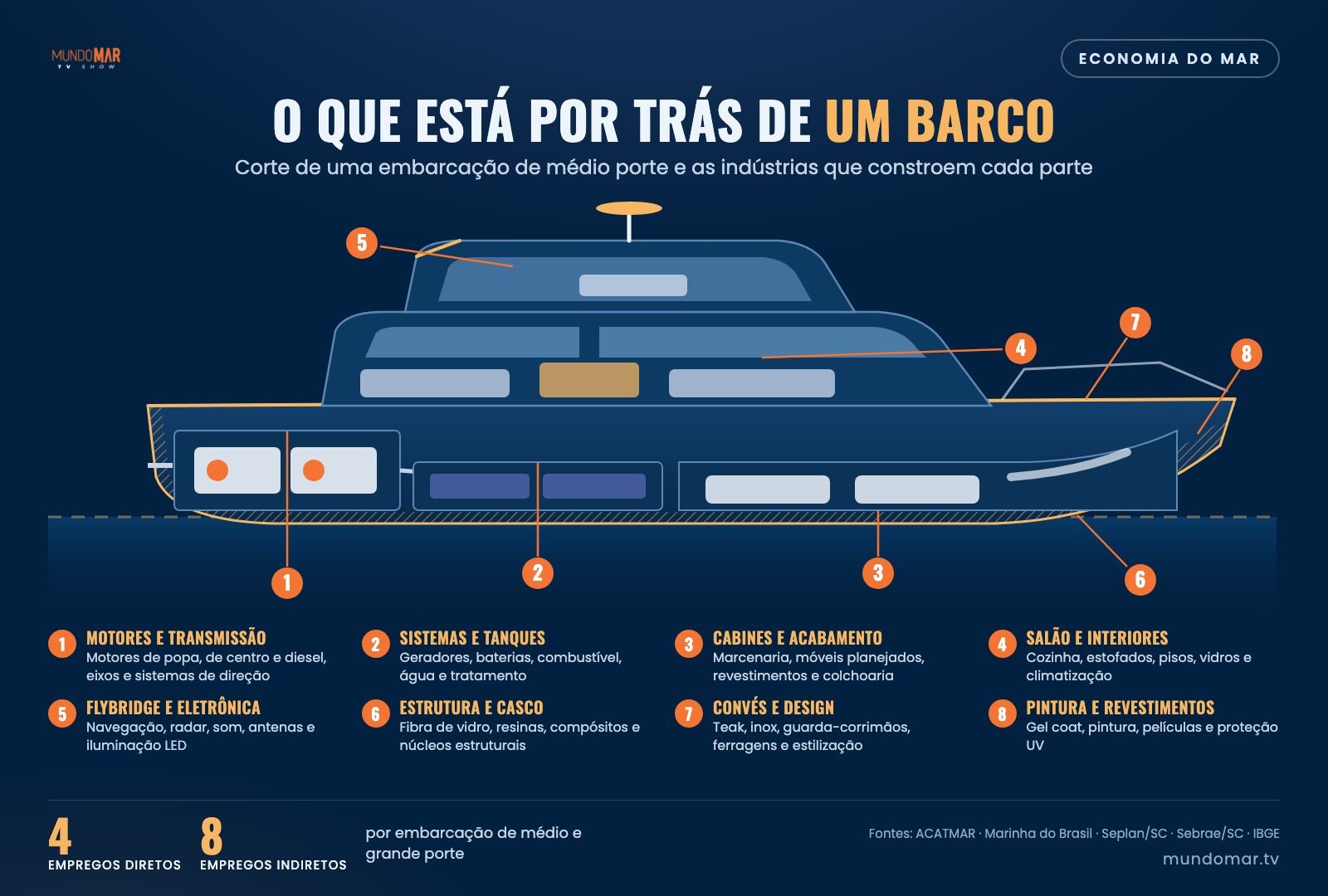
A shipyard is, in practice, an integrator of supply chains. And that is why the next figure matters so much.
How many jobs a boat generates
Every medium and large vessel generates, on average, 4 direct jobs and 8 indirect jobs, according to ACATMAR.
That is, for every job inside the shipyard, two more open up outside it: at the stainless steel supplier, at the joinery, at the marine electronics store, in transport, at the marina that will host that boat and in the service that will maintain it for the next twenty years. Twelve families per hull that leaves the factory.
Santa Catarina's turnaround: from 94 to more than a thousand companies
This is the most striking finding of this report, and it only appears when you compare the past with the present.
The Sector Study of Santa Catarina Industry, produced by Sebrae/SC within the Nova Economia@SC programme, portrayed the state's marine sector at the start of the 2010s. The picture was this:
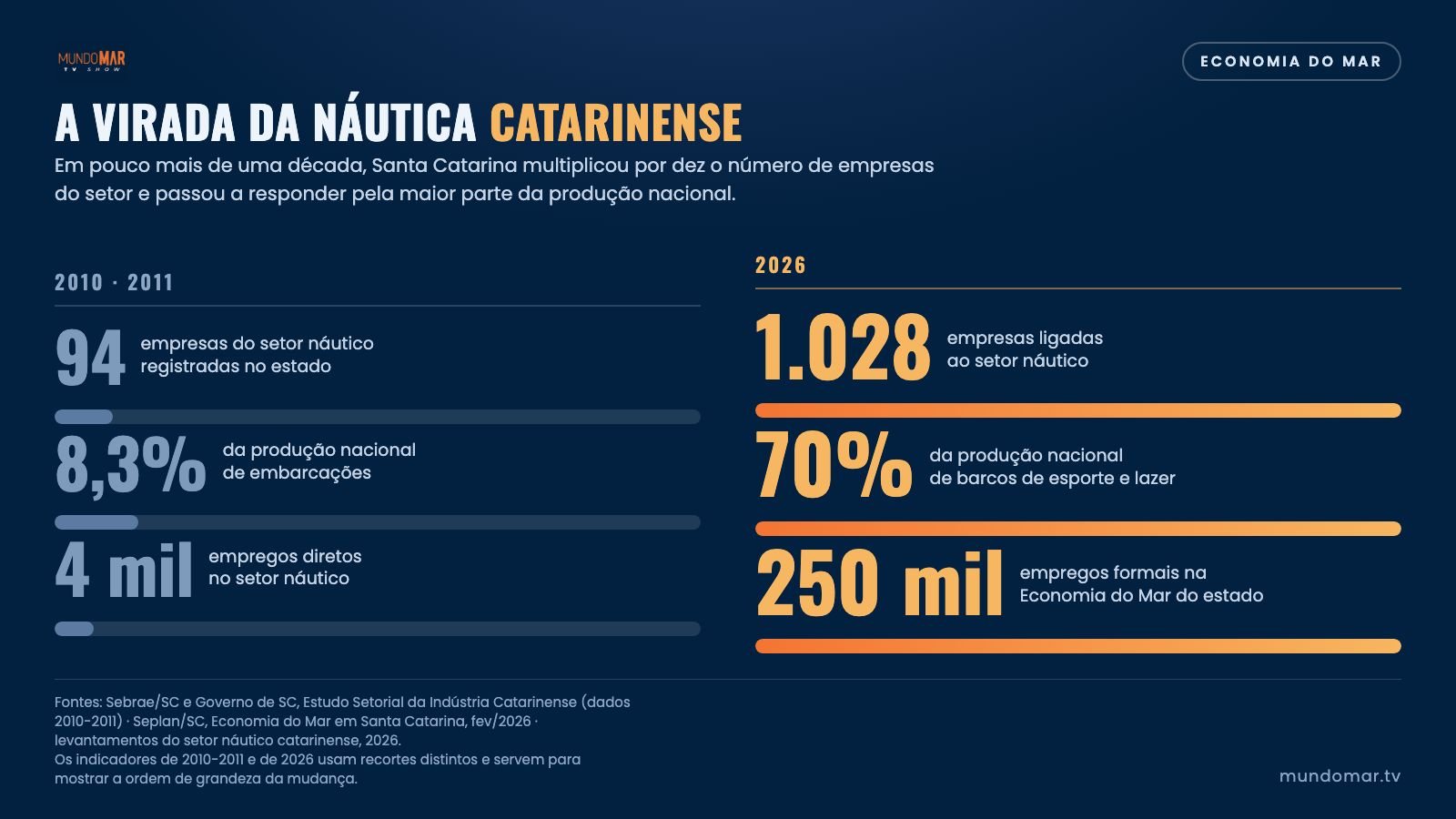
- In 2011, Santa Catarina had 94 registered marine sector companies, 11.2% of the country's total
- The state's boat production represented 8.3% of national production (PIA/IBGE, 2010)
- The sector generated just over 4,000 direct jobs in the state
- The sector's Fiscal Added Value was R$ 96.5 million, only 0.08% of Santa Catarina's total
- The sector's exports totalled just over US$ 320,000, against US$ 31 million in imports
Now compare with 2026:
| Indicator | 2010 / 2011 | 2026 |
|---|---|---|
| Marine sector companies in SC | 94 | 1,028 |
| Share of national production | 8.3% | 70% |
| Direct jobs in the marine sector | just over 4,000 | part of the 250,000 in the Ocean Economy |
| Sector exports | US$ 320,000 | 74% of Brazil's leisure boat exports |
Today, Itajaí concentrates 165 companies, while Florianópolis, São José, Palhoça and Biguaçu together account for 285, about 30% of the state total. There are 50,000 recreational vessels registered in the state.
In little over a decade, the number of companies multiplied tenfold and the share of national production jumped from 8.3% to 70%. Few sectors of the Brazilian economy show a transformation of this magnitude.
Santa Catarina's ocean economy in official figures
Here the data comes from the bulletin Ocean Economy in Santa Catarina, published in February 2026 by Seplan, the State Planning Secretariat, based on RAIS and the Novo Caged register of the Ministry of Labour.
The current size
- The Ocean Economy sustains 250,000 professionals with formal contracts in Santa Catarina
- That equals 8.5% of all formal workers in the state
- In 2024 there were 239,671 formal jobs, spread across more than 23,500 establishments
- The group moves R$ 1.158 billion in payroll every month
The growth
- Between 2014 and 2024, employment in Santa Catarina's Ocean Economy grew 25%, an increase of almost 50,000 workers. In Brazil, growth was around 15%
- The number of establishments went from 15,871 to 23,515, a rise of 48%
- Payroll rose 20% compared with December 2014, when it was R$ 964 million
- Between March 2025 and February 2026, the sector opened 5,881 new formal positions, equal to 13% of the state's entire job creation balance. In Brazil, these activities accounted for 12%
- In February 2026 alone there were 1,929 new contracts, or 11% of the national total for these activities
Where the jobs are
Santa Catarina's Ocean Economy is more industrial than the state average. While Industry accounts for 28% of total formal employment in Santa Catarina, within the Ocean Economy it reaches 44.5%. Services follow with 36.8%, then Retail (12.3%), Construction (5.1%) and Agriculture (1.2%).
In the twelve months ending February 2026, the groups that created the most jobs were:
- Warehousing, loading and unloading: +1,744 positions
- Maintenance and repair of machinery and equipment: +1,206
- Manufacture of other food products: +967
- Architecture and engineering services: +965
- Boatbuilding: +109
Where Santa Catarina leads Brazil
Within the 30 CNAE groups that make up the Ocean Economy, the state ranks:
- 1st nationally in Fishing, concentrating 45% of the country's formal jobs in that group, and in Fish preservation and processing, with 27%
- 2nd in Boatbuilding, Manufacture of engines, pumps and compressors (22% of national jobs), Manufacture of measuring instruments and Manufacture of fishing and sports goods
- 3rd in Warehousing, loading and unloading, Auxiliary waterway transport activities and Other waterway transport
In the overall ranking by number of jobs in the Ocean Economy, Santa Catarina holds 7th place among the federative units. With 5% of the sector's jobs in the country, the state punches well above its population.
| Position | State | Formal jobs in the Ocean Economy (2024) |
|---|---|---|
| 1st | São Paulo | 1.3 million |
| 2nd | Rio de Janeiro | 542,000 |
| 3rd | Minas Gerais | 519,000 |
| 4th | Federal District | 373,000 |
| 5th | Paraná | 286,000 |
| 6th | Bahia | 255,000 |
| 7th | Santa Catarina | 239,671 |
The geography of employment
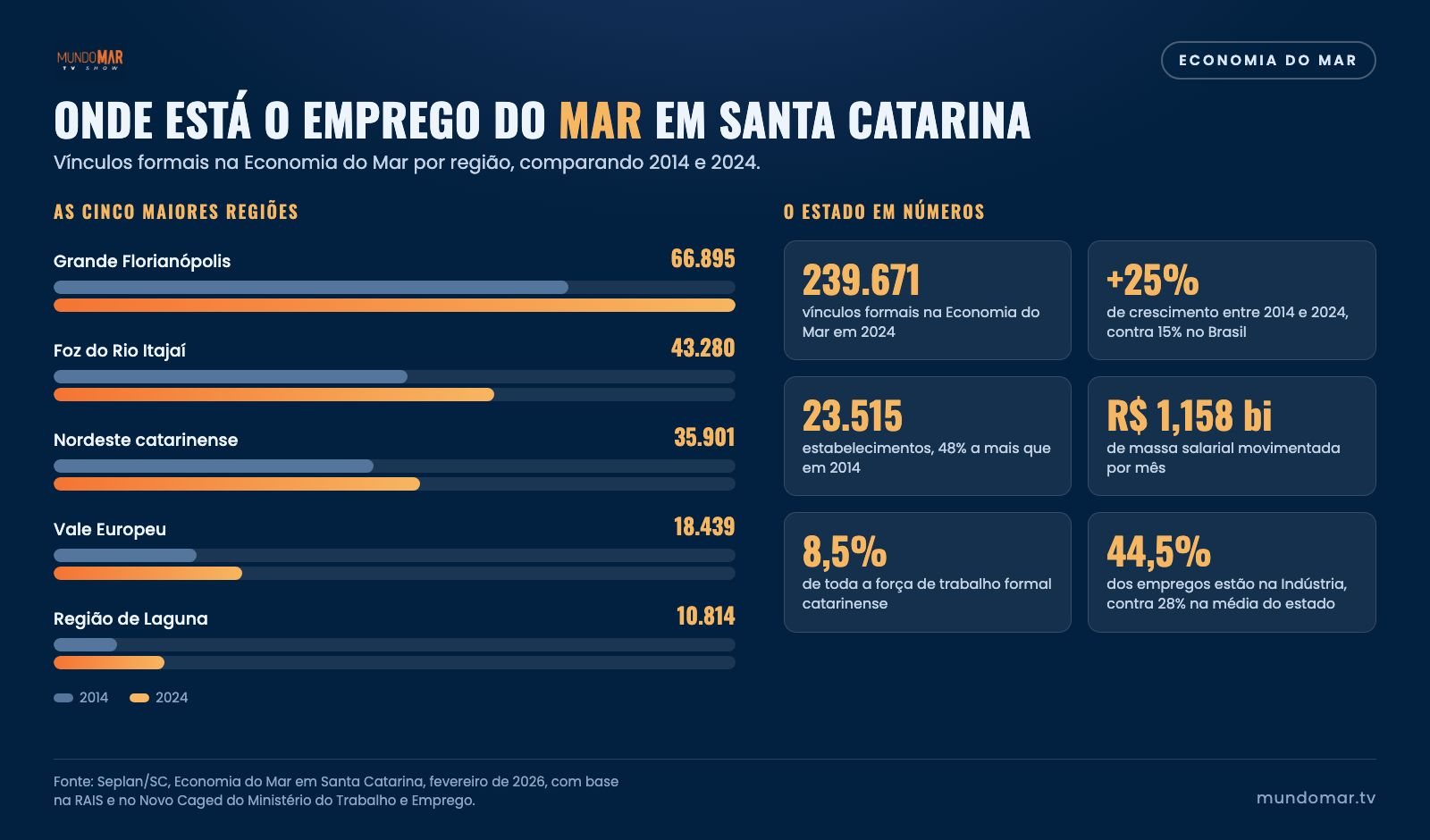
Three regions concentrate 61% of formal Ocean Economy jobs in Santa Catarina: Greater Florianópolis (28%), the Itajaí River Mouth region (18%) and the Northeast of the state (15%). The municipalities with the most workers in these activities are Florianópolis, Joinville and Itajaí, which together account for more than 82,000 formal jobs.
It is worth noting who grew most: between 2014 and 2024, Ocean Economy employment advanced 77% in the Far West and 73% in the Laguna region, showing the activity is not confined to the traditional coastline.
Who works in the sector
- Micro and small companies generated 65% of new jobs in the last twelve months. They represent 98.3% of Ocean Economy establishments in Industry and Construction
- Among new hires, 51% are men and 49% women. In the total stock the ratio is 63% and 37%, still more balanced than the national average of 70% and 30%
- Education levels rose: 53% of workers have completed secondary education and 20% have higher education. In 2014, those figures were 46% and 16%
Brazil from above: the national fleet
Fleet data comes from the Brazilian Navy, the body responsible for registering vessels in the country:
- 1.14 million vessels were actively registered between 1995 and 2025
- The 8th Naval District, covering Paraná, São Paulo and southern Minas Gerais, concentrates 427,000 vessels, or 37% of the entire national fleet
- São Paulo alone has 240,981 registered vessels, around 24% of the country's total
To gauge the leap, the 2012 Brazilian Marine Industry Report estimated the recreational fleet above 16 feet at around 70,000 vessels. Production is concentrated in the South and consumption in the Southeast, and this geography explains much of the sector's logistics.
Nautical tourism enters the equation
A moored boat generates no economy. What turns a fleet into income is use.
São Paulo has put a number on it: the state government's Nautical Tourism Programme aims to raise the sector's turnover from R$ 6.3 billion to R$ 21 billion by 2033, with 60 public navigation support structures planned in the same period.
The market is responding. At the 2025 São Paulo Boat Show, 750 vessels were sold, up 7.1% on the 700 of the previous year, with 120 brands, 170 boats on display and 40,000 visitors.
The figure still missing: the Ocean GDP
Despite all this data, Brazil still has no official measure of the ocean economy's weight in GDP. That is changing.
A technical group coordinated by the National Planning Secretariat of the Ministry of Planning and Budget, in partnership with the National Accounts Coordination of IBGE, completed the Methodology for Measuring the Ocean Economy in Brazil, approved by the Interministerial Commission for Marine Resources in October 2025. The next step is its application by IBGE and the release of the first results.
When that figure arrives, the sector stops relying on estimates and gains official statistics. It is the difference between arguing and proving.
The challenges on the table
Tax reform. The transition may raise the burden on the sector, and the qualification window for the compensation fund closes in December 2028. It is the industry's most urgent issue today.
The shortage of qualified labour. The sector is growing faster than it can train people. There is a shortage of professionals in lamination, mechanics, electrical work, joinery and marina operations. This is not new: back in 2014 the Sebrae study already flagged the lack of qualification as one of the main obstacles to growth, alongside the infrastructure deficit and slow licensing of piers and marinas. ACATMAR maintains training programmes and a partnership with IFSC to set up the Escola do Mar.
The technological transition. The Technological Plan for Santa Catarina's Marine Sector, built with foresight methodology and circular economy principles, points the way: decarbonisation, automation, hybrid engines, low-emission fuels, electrification and autonomous vessels. The document also highlights the strong dollar as a factor favouring the competitiveness of the state's marine exports, expanding markets in Europe, North America and the Middle East.
What the numbers say, in the end
Add it all up: 1.14 million vessels registered in the country, 250,000 people employed in Santa Catarina's ocean economy alone, more than 23,000 establishments and R$ 1.158 billion in monthly payroll in a single state, 1,028 marine companies where there were 94 little over a decade ago, and a chain of eight different industries behind every hull.
In ACATMAR's assessment, the growth potential remains significant, and Santa Catarina's blue economy could advance around 10% a year, provided the state keeps investing in infrastructure, training and incentives for the sector.
None of this is luxury. It is industry, it is jobs, it is tax revenue and it is development. Next time someone says boats are a rich person's thing, show them the bill.
Sources
The data in this report was compiled from:
- SEPLAN/SC, Santa Catarina State Planning Secretariat. Ocean Economy in Santa Catarina, February 2026, based on RAIS and Novo Caged of the Ministry of Labour and Employment
- SEBRAE/SC and the Government of Santa Catarina. Sector Study of Santa Catarina Industry: Marine, Nova Economia@SC programme, with data from RAIS, IBGE and AliceWeb
- Brazilian Navy: registration and distribution of the national fleet
- MPO and IBGE: Methodology for Measuring the Ocean Economy in Brazil, approved by CIRM in October 2025
- ACATMAR, Brazilian Nautical Association: jobs generated per vessel, supply chain structure and growth projection for Santa Catarina's blue economy
- Technological Plan for Santa Catarina's Marine Sector: technological trends and circular economy
- Government of the State of São Paulo: Nautical Tourism Programme
- ICOMIA, International Council of Marine Industry Associations: global market data
- Santa Catarina marine sector data published by the specialised press
This report is updated as new official data is released. If you work in research, the press or public policy and need sector information, get in touch with us.
By: Redação Mundo Mar
Photo: Foto e infográfico: Mundo Mar