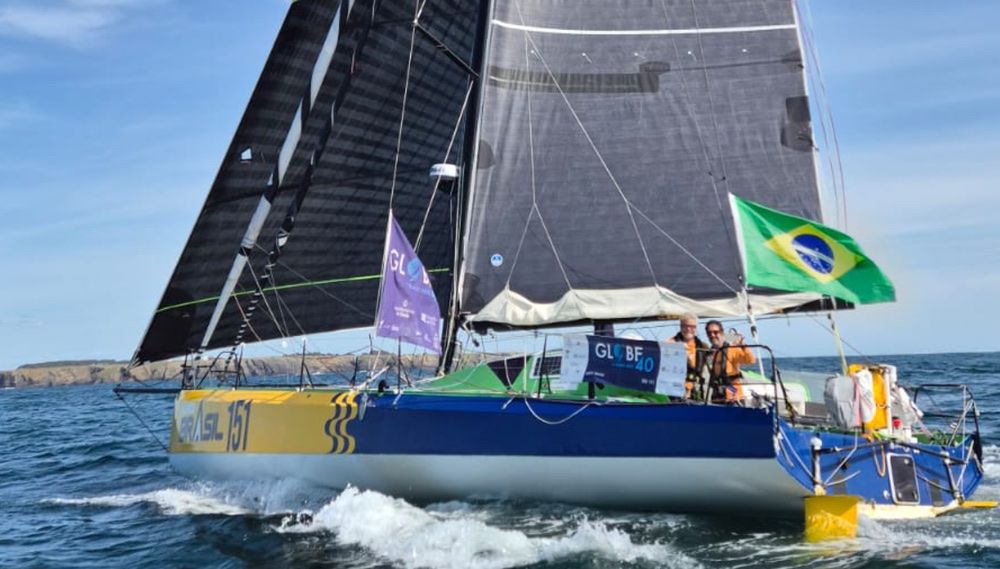
The Barco Brasil wrote a historic chapter in Brazilian ocean sailing this Sunday (the 20th). Sailors José Guilherme Caldas and Luiz Bolina won the Globe40 title, the doublehanded round-the-world race, among the Sharp boats. They also secured third place overall in the contest, behind the French Crédit Mutuel, the overall champion, and the Belgium Ocean Race, runner-up, both boats in the Scow category.
The last leg, with 4,290 nautical miles between Recife (BRA) and Lorient (FRA), was completed in 20 days and summed up the resilience of the Brazilian campaign. After a challenging start near the country's northeast coast, marked by the presence of sargassum that hampered the boat's speed, the Brazilian team took control of the contest in the Sharp class and began to manage the advantage over its main direct rival, the Canadian Wilson Around The World.
As they approached Spain, in conditions of stronger wind, with gusts of 40 knots, the spinnaker tore, momentarily compromising the vessel's performance. The incident allowed the Free Dom to close in, crossing the finish line first among the Sharp boats. Even so, the Barco Brasil arrived just five nautical miles behind, securing the category title in the overall standings.
"It is incredible that, after so many days of racing, we arrive practically at the same minute! The Barco Brasil is the champion of the Globe40 in the Sharp class, and we are third overall. We would have liked to win this last leg, but the fact that we secured the title shows that we did well in the competition as a whole, which is what really matters," highlighted José Guilherme Caldas.
A winning campaign
The Brazilian campaign was marked by consistency and a high technical level, with a podium presence in six of the seven Globe40 legs: three wins (Cádiz, Mindelo and Sydney), three second places (Prologue, Réunion and Recife) and a fifth place in Valparaíso.
The achievement gains even more relevance given the conditions faced by the pair. The Barco Brasil was the only team in the competition without a sponsor, without a complete professional structure and without reserve crew. On board, just two amateur sailors throughout the round-the-world race. Skipper José Guilherme Caldas also combined the competition with his work as a doctor in São Paulo, treating patients during the stopovers of the race.
The achievement places the Barco Brasil in a select group of national sailing. This was only the second Brazilian participation in a round-the-world race, after the historic Brasil 1, skippered by Torben Grael, which finished third in the 2005/2006 Volvo Ocean Race.
Visibility against stroke
More than the sporting contest, the Barco Brasil was born to broaden the promotion of the campaign for the prevention and fight against stroke. Skipper of the Barco Brasil alongside Luiz Bolina, Professor José Guilherme Caldas developed tools for the treatment and monitoring of stroke. The Globe40 project seeks to show that knowledge and action save lives, turning the ocean into a metaphor for overcoming challenges and awareness.
The Globe40
Considered one of the greatest challenges of doublehanded world sport, the Globe40 is contested with Class40 boats, 40-foot vessels that are extremely demanding, with no comfort on board and prepared to face extreme sea and weather conditions. The competition uses a cumulative scoring system in which the winner is the one who totals the fewest points, with the Class40 boats divided between the Scow (wide bow) and Sharp (narrow bow) categories. The second edition featured seven international teams, with a prologue in Lorient and legs in Cádiz, Mindelo, Réunion, Sydney, Valparaíso and Recife, before the final arrival in France.
By: Redação Mundo Mar
Photo: Divulgação