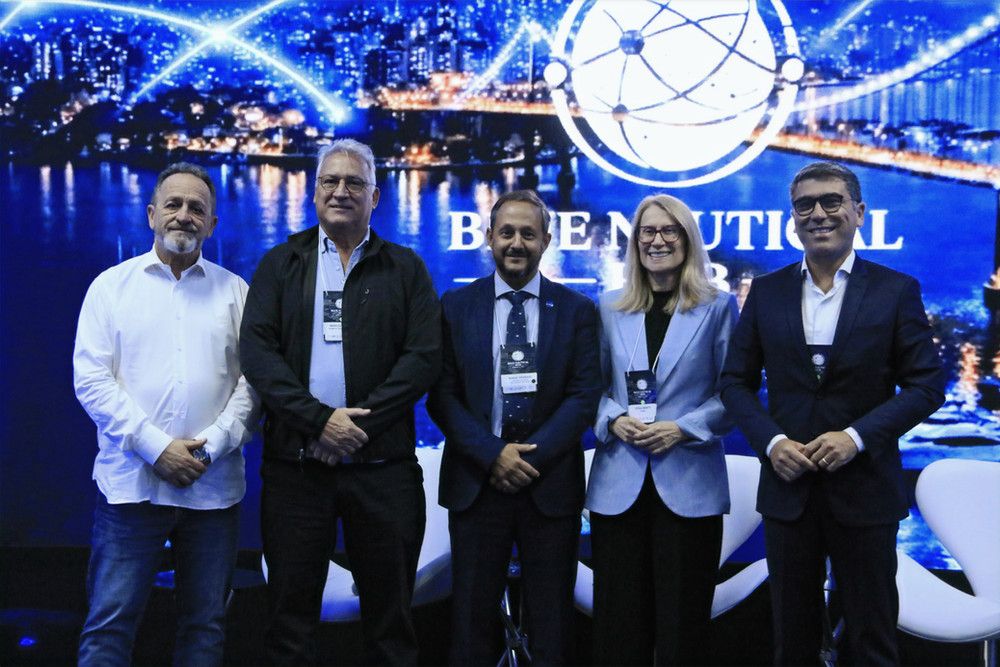
The Blue Nautical Hub Brasil 2026 wrapped up its programme leaving as its main legacy the consolidation of a strategic connection platform for the Ocean Economy. During an intense week, the event brought together entrepreneurs, specialists, public-sector representatives, national and international bodies, shipyards, marinas, suppliers, sector professionals and political leaders on an agenda focused on knowledge, business, institutional coordination and the strengthening of the Brazilian nautical production chain.
Held from 26 April to 1 May, in Santa Catarina, the Blue Nautical Hub Brasil combined technical visits, the 3rd International Blue Economy Symposium, a business meeting, institutional meetings, a gathering of the Cofradía Europea de la Vela, discussion panels, lectures, qualified networking and concrete deliverables for the sector. More than an event, the Hub positioned itself as an environment of collective building, connecting those who produce, invest, regulate, research, undertake, represent and develop the Ocean Economy in Brazil and abroad.
Technical visits connected entrepreneurs to the sector's productive reality
The programme began with a technical immersion in some of the main hubs of Santa Catarina's nautical industry, infrastructure and services. The first day started in Itajaí, with visits to Azimut Yachts, the OKEAN Shipyard, the operation linked to the production of Ferretti Yachts vessels in Brazil, Fibrafort and Marina Itajaí, ending in Itapema, at the new Píer O Porto.
On the second day, the entrepreneurs visited the Freguesia Marine Farm, in Santo Antônio de Lisboa (Florianópolis), a Schaefer Yachts unit with its exclusive 5-axis CNC machine, the Pier 33 Marina, Schaefer's second manufacturing plant in Palhoça and the Sessa Marine Brasil / Intech Boating shipyard. At many stops, the groups had direct access to CEOs, presidents and directors, creating an environment of qualified relationship building between decision-makers.
The technical visits ended at the foot of the iconic Hercílio Luz Bridge, in Florianópolis, which turns 100 in 2026, at Schaefer Yachts' third unit. On the occasion, the president of Schaefer Yachts, Márcio Schaefer, and his partner Pedro Odílio Phelippe welcomed the participants and shared part of the journey that helped drive the development of the nautical sector in Santa Catarina.
The 3rd International Blue Economy Symposium broadened the debate
One of the central moments of the week was the 3rd International Blue Economy Symposium, which brought together specialists, entrepreneurs, institutional leaders and public-sector representatives. The programme covered themes such as nautical infrastructure, marina development, the recreational shipbuilding industry, nautical tourism, sustainability, governance, innovation, tax reform, Mercosur, internationalisation, professional training and territorial planning.
Ocean Economy data opens a new stage for the sector
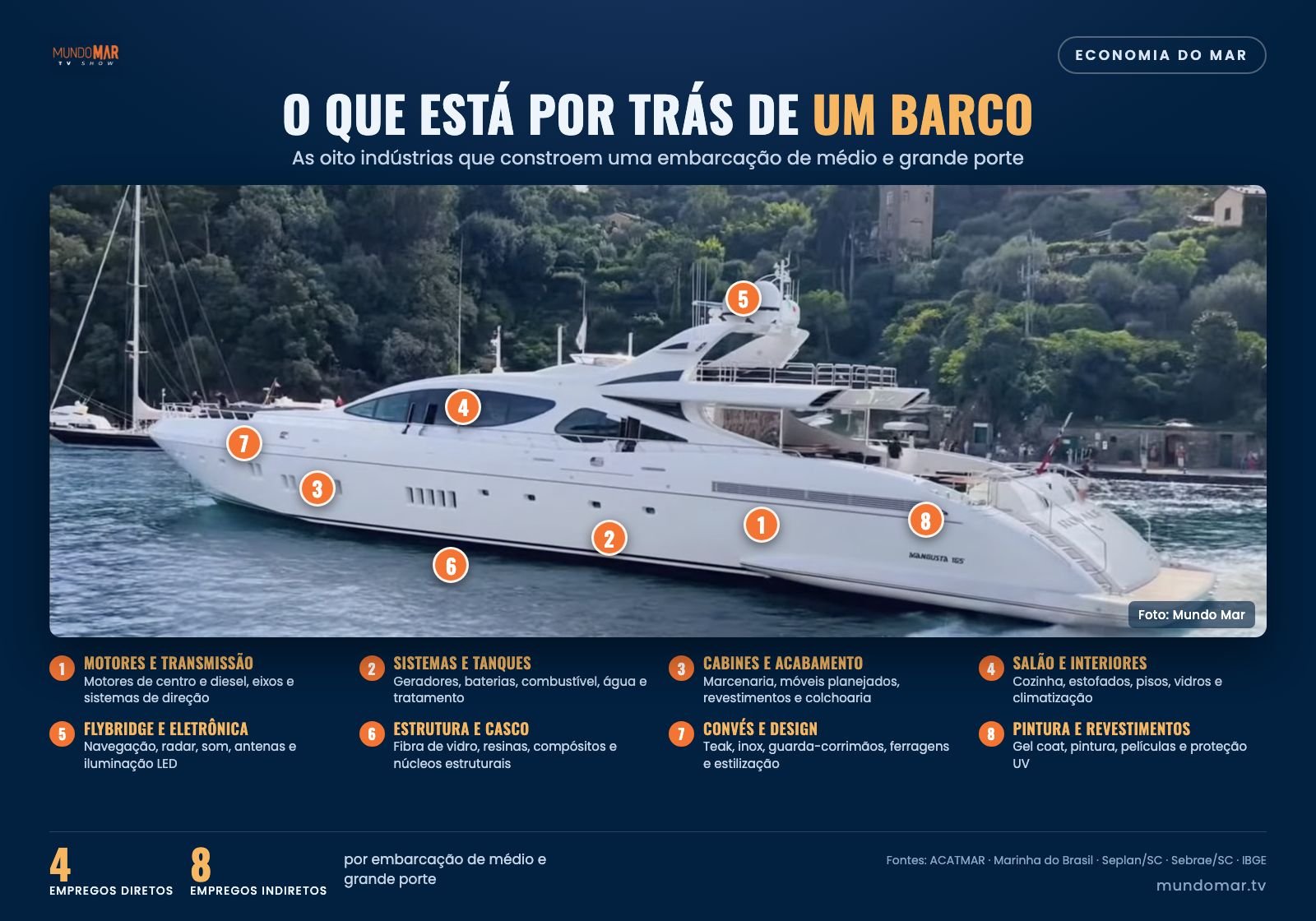
Among the most relevant moments was the presentation of the Ocean Economy data in Santa Catarina, led by the State Government through the State Planning Department (SEPLAN). According to the survey, this set of activities gathers approximately 240,000 formal workers, distributed across more than 23,000 establishments, with a monthly payroll of around R$ 1.158 billion.
The study also indicated that, between March 2025 and February 2026, the Ocean Economy accounted for approximately 6,000 new formal jobs (13% of the state's total balance in the period). In 2024, the sector employed 239,671 formal workers in Santa Catarina, 45% of them in industry.
As a direct outcome of this agenda, a cooperation agreement was signed between the Government of Santa Catarina and ACATMAR (Associação Náutica Brasileira) for the sharing of economic information and indicators. Sebrae/SC also played a strategic role as a coordinator of the Hub, alongside ACATMAR, bringing together the productive sector, small businesses, suppliers, marinas, shipyards and specialists.
Political coordination and the Marina-School Project
The Blue Nautical Hub Brasil also promoted moments of political coordination, with a highlight on the meeting with the president of the Parliamentary Front for the Ocean Economy, senator Esperidião Amin. One of the most important acts was the presentation of the Blue Economy Extension Programme – Âncora Project: Marina-School, delivered by Prof. Dr. Vinicius De Luca Filho, director-general of the Florianópolis-Continente Campus of the Federal Institute of Santa Catarina (IFSC). The proposal simulates the real dynamics of a marina, integrating teaching, extension, research, innovation, ocean culture, nautical tourism, services and coastal governance.
B2B business meeting aboard a vessel
Another major highlight was the B2B Business Meeting, held for the first time aboard a vessel. ACATMAR mobilised anchor companies, shipyards, marinas and leaders with decision-making power, while Sebrae/SC applied its business-meeting methodology. The meeting brought together around 70 companies, connecting suppliers, shipyards, marinas, service providers and potential commercial partners, with the participation also of representatives from the United States and Europe.
The Cofradía Europea de la Vela strengthened the international dimension
The programme also featured the gathering of the Cofradía Europea de la Vela, an international body linked to maritime culture, sailing and nautical tradition. Its presence broadened the international dimension of the event and reinforced the importance of nautical culture as an essential part of the Ocean Economy, in a symbolic moment of closer ties between Brazil and Europe.
The next edition is already being built
With the results achieved, the Blue Nautical Hub Brasil is already planning its next steps. The April 2027 edition should further expand the connection proposal, including new international opportunities, business rounds, technical debates, visits and institutional coordination. The building started in 2026 leaves a clear message: Brazil has the potential to play a much more relevant role in the Ocean Economy, but this requires connection, data, strategic vision, cooperation and leadership.
By: Redação Mundo Mar
Photo: Mundo Mar