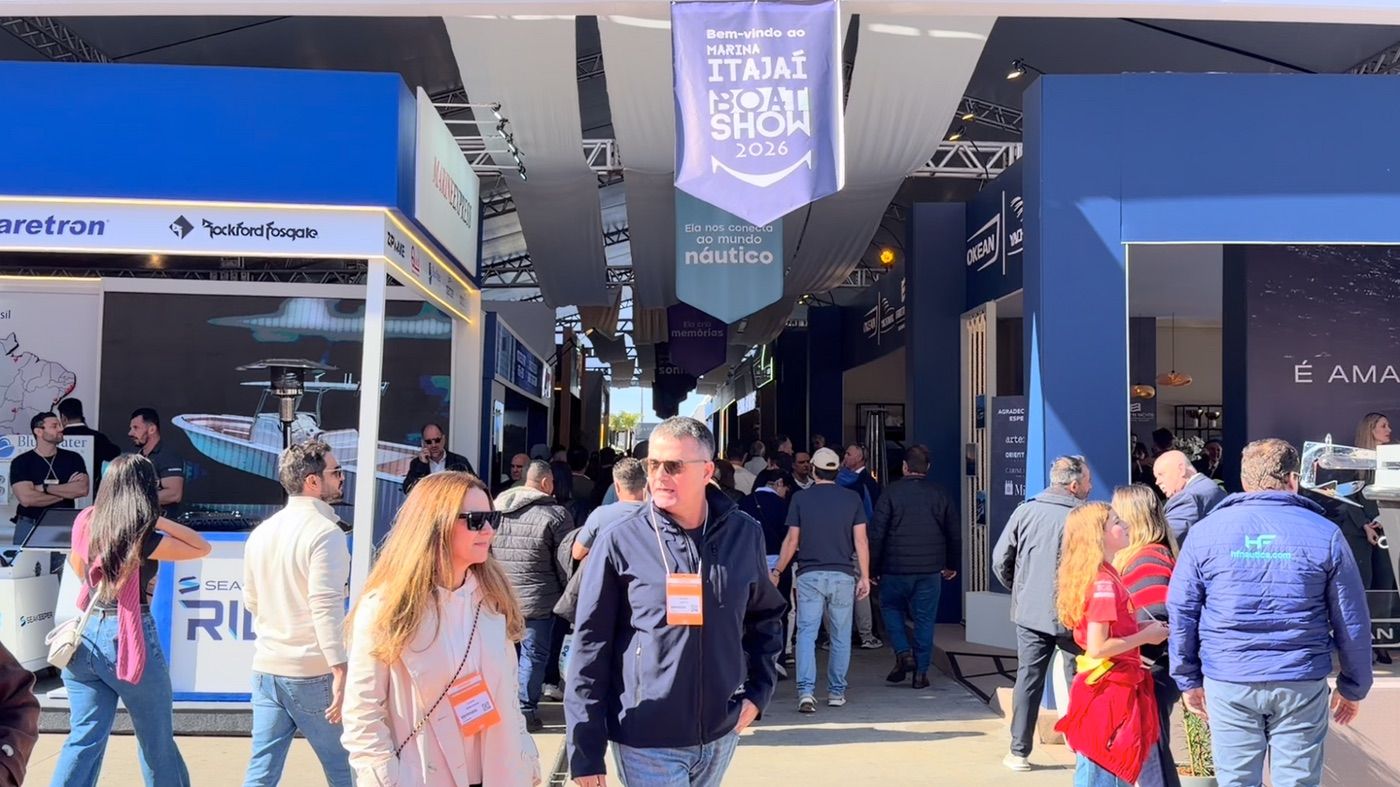
For four days, Marina Itajaí ceased to be merely the address of a nautical show to become a meeting point between industry, commerce, services, tourism, technology, knowledge and the public sector.
Held from 2 to 5 July, the Marina Itajaí Boat Show 2026 closed its fourth edition showing that the economic value of a vessel does not end at the shipyard. Around each boat there is a chain made up of engines, electronic equipment, marinas, floating infrastructure, maintenance, insurance, credit, professional training, gastronomy, accommodation, real estate, tourism and countless specialised services.
The event gathered more than 60 vessels, with models from approximately 19 to 100 feet, in addition to engines, jet skis, accessories, equipment and technologies for navigation. Being held in an environment integrated with the Itajaí-Açu River meant that a large part of the boats could be presented on the water and that some models took part in test-drives.
An event that began with institutional weight
The opening ceremony gathered municipal authorities, representatives of the Brazilian Navy, leaders of sector bodies, entrepreneurs and leaders of the marine industry. Taking part in the official ceremony were the mayor of Itajaí, Robison Coelho; the deputy mayor Rubens Angioletti; the municipal secretary for Economic Development and Innovation, Rodrigo Bonfanti; the president of Grupo Náutica, Ernani Paciornik; the director of Marina Itajaí, Carlos Gayoso; the founder of Marina Itajaí, Manuel Carlos Maia de Oliveira; the president of ACATMAR, Leandro "Mané" Ferrari; and Captain Warisson Guimarães Alves, head of the Itajaí Ports Authority.
The joint presence of these leaders showed that the sector is beginning to occupy a broader space in discussions about economic development. The nautical world has come to be seen not only as a leisure activity, but as an economy capable of generating jobs, exports, tax revenue, innovation and professional opportunities.
From entry-level boats to large yachts
The diversity of vessels was one of the important points of this edition. Visitors found everything from compact models geared to first sailing experiences to large yachts with sophisticated designs, generous social areas and advanced engineering solutions.
Azimut Yachts presented the models produced at its Brazilian plant, based in Itajaí, the brand's only industrial unit outside Italy. Schaefer Yachts brought a diverse range and had among its highlights the Schaefer 600, with retractable side balconies, three suites and integrated spaces, as well as models such as the V34. The Ferretti 850R, reinterpreted by Grupo OKEAN for the Brazilian market, drew attention for the new stern configuration. Sessa presented the F60 with T-Top, built in Italy from a project developed for the Brazilian public.
Among the debuts were also the Ventura V370 Crossover, the Ross SLR 340 Legend, the FS 375 HT, the Focker 355 GTS and the Diantonio Ghost. Garnet Offshore took part in the Santa Catarina show for the first time with two catamarans, including options geared to fishing and operational efficiency.
JAQ H1 became a stage for innovation and knowledge
One of the most symbolic elements of the event was the presence of the JAQ H1, a 36-metre Brazilian vessel created to serve as a school boat and floating laboratory. The project uses a fuel cell fed by low-carbon hydrogen to generate the energy needed for the hospitality systems, with plans to evolve into a hybrid propulsion system.
More than remaining moored as a technological attraction, the JAQ H1 was incorporated into the programme. The vessel hosted the performance of the Navy Band during the opening and was the venue for the Náutica Talks, a cycle of panels and debates that in this edition was jointly curated by Grupo Náutica and Mané Ferrari, president of ACATMAR (Associação Náutica Brasileira). On board, subjects related to the Blue Economy, innovation, the Defence Industrial Base, sustainability, nautical tourism, infrastructure, economic development and professional training were discussed.
The JAQ H1 also hosted a presentation on the expected impacts of the next The Ocean Race stopover in Itajaí, in 2027. The study released during the event estimated economic activity of R$ 270 million, an audience of approximately 420,000 people and a return of R$ 6.75 for every real invested in the stage. These figures are projections related to The Ocean Race 2027, not to the Boat Show.
Technology appeared inside and outside the vessels
The floating nautical shopping area broadened the presence of suppliers of equipment, electronics, propulsion, infrastructure, accessories and services. Among the solutions presented were desalinators capable of turning salt water into fresh water on board, with output announced at between 130 and 360 litres per hour.
Engines also occupied a significant space. Volvo Penta, Yanmar, Yamaha and Hidea presented solutions for launches, sailboats and different power ranges. Kawasaki presented 11 jet skis, and the public also found the 2026 Sea-Doo range and Can-Am vehicles. Another product that sparked curiosity was the Wave Boat Mormaii, a structure attached to a jet ski that can carry up to 11 people. Floating infrastructure companies such as PierPlas were also present.
Experiences brought families closer to sailing
Sailing trips, navigation on a solar-powered boat and test-drives created opportunities for new audiences to have contact with the water. The solar boat of the Vento Sul team, of the Federal University of Santa Catarina, offered an electric, silent and emission-free sailing experience. The sailing trips held in partnership with the Itajaí Sailing Team also brought visitors closer to nautical practice.
Building a consistent nautical market depends not only on current buyers, but on creating a culture linked to sailing, safety, sport, tourism and sea-related professions.
Fashion, cars, real estate and gastronomy broadened the reach
The fashion space hosted activations and the FIT Fashion Show, while the food court created a social area overlooking the Itajaí-Açu River. Cars from brands such as McLaren and Lamborghini also drew attention, establishing a connection between the nautical market and other sectors linked to mobility, design and the high-end segment. In the real estate market, 11 developments took part in the display, showing the growing relationship between marinas, residences, planned neighbourhoods, tourism and the appreciation of urban areas near the water.
The figures that can already be confirmed
The Marina Itajaí Boat Show 2026 gathered more than 60 vessels and 11 real estate developments, in addition to dozens of companies from the engine, accessories, services, technology, infrastructure and lifestyle segments. The organisers were working with the expectation of surpassing the mark of 20,000 visitors. As a reference, the 2025 edition recorded 22,000 people, of whom 18% came from Paraná.
The real value lies in the chain the event made visible
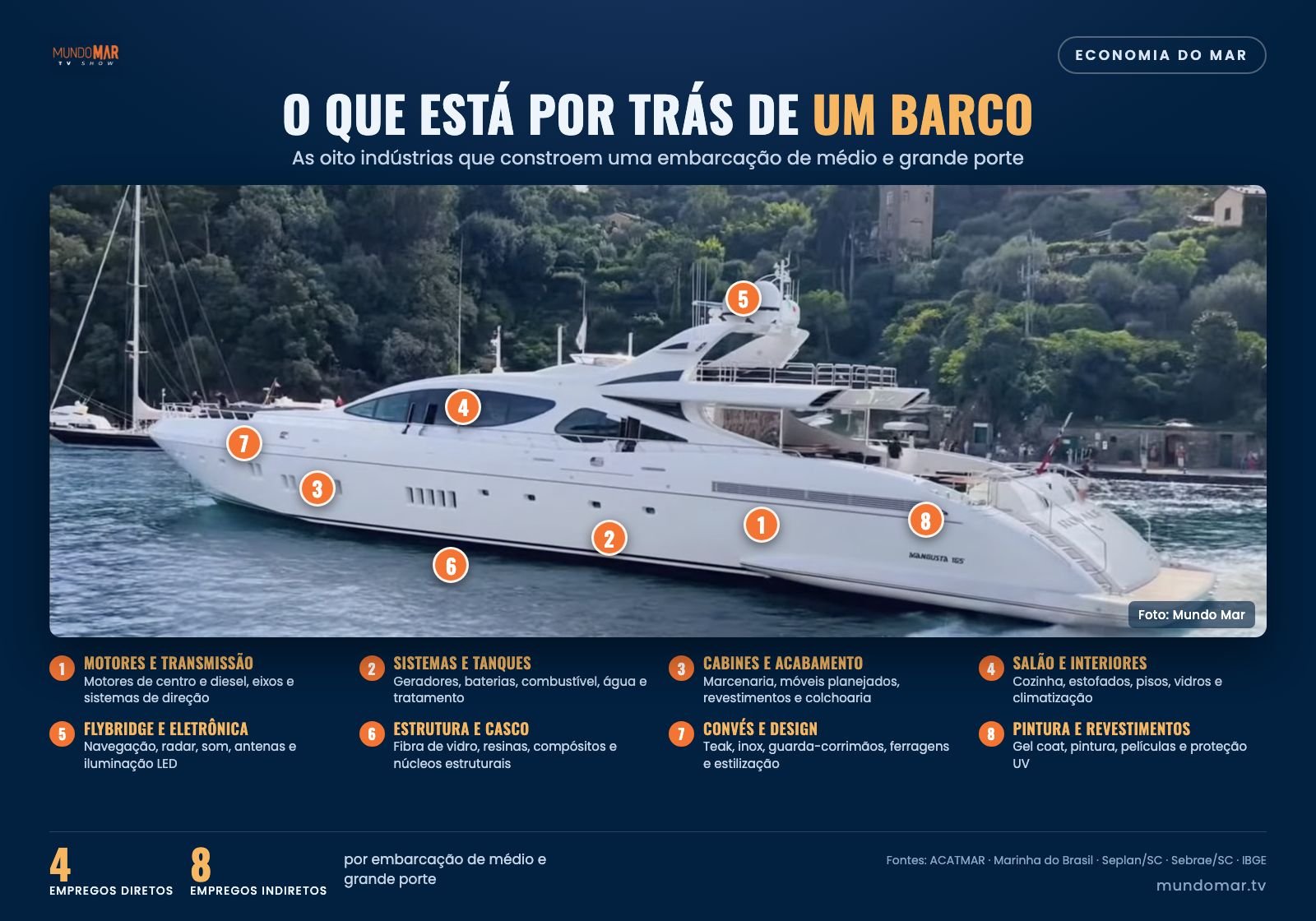
For a vessel to reach the water, professionals in design, engineering, lamination, joinery, electrics, mechanics, painting, finishing and quality control are needed. After the sale, marinas, fuelling stations, workshops, shipping agents, insurance, safety equipment, electronics, training, tourism, food and accommodation come into play.
This is perhaps the greatest result of the 2026 edition: to show, in a concrete way, that the Ocean Economy of the nautical sector is not summed up by the value of a boat. It is measured by the number of jobs, services, deals, technologies and opportunities created around it. When industry, tourism, knowledge, the public sector and private initiative sail in the same direction, the nautical sector stops being merely a possibility and becomes a strategic part of the country's economy.
By: Redação Mundo Mar
Photo: Mundo Mar